
A Bible Story, a Box of Crayons, and the Science of Healing — Built for the Front Lines
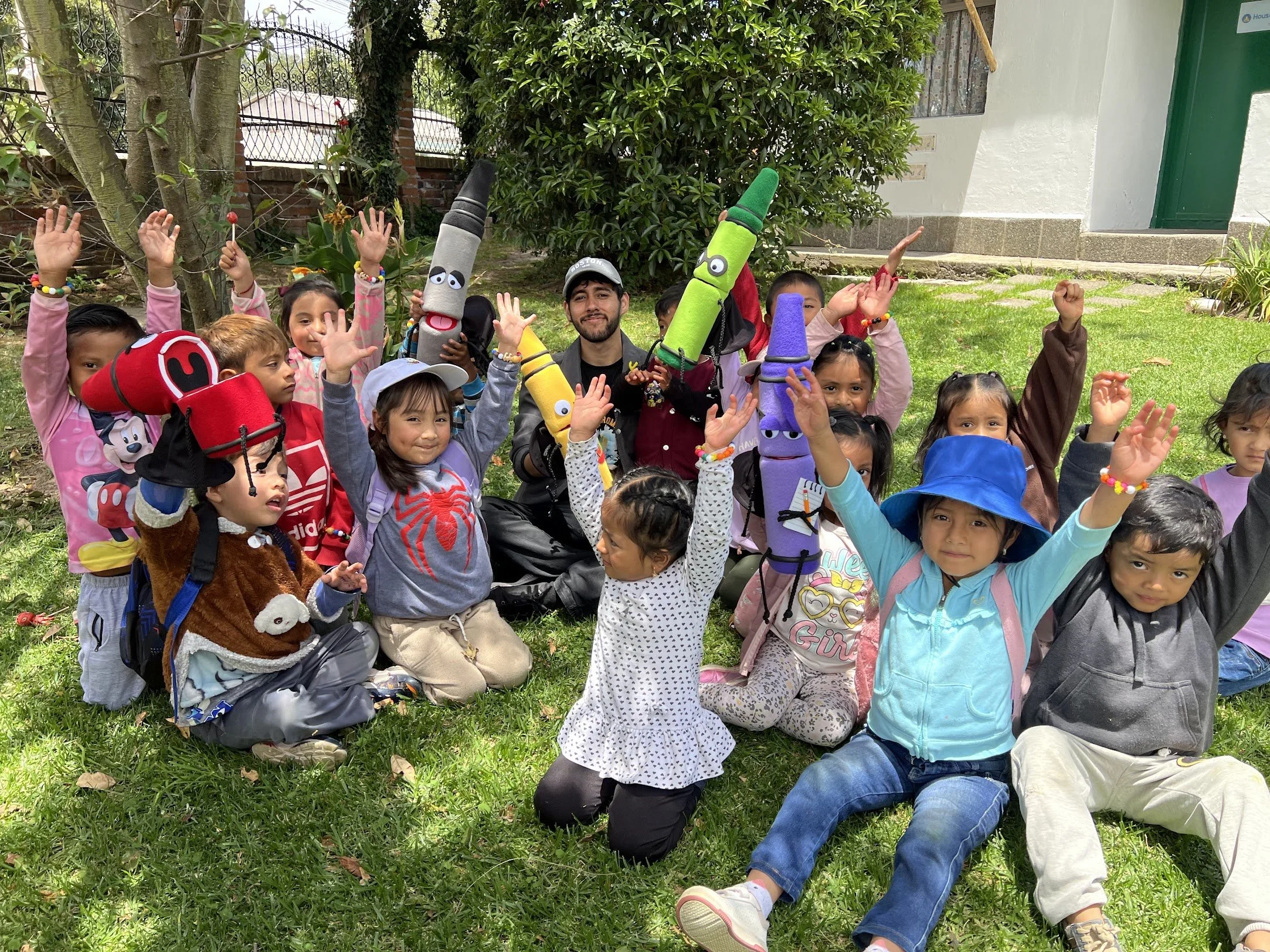
Somewhere in the middle of a disaster relief project in Ecuador, Tamitha Lynch turned to her friend and colleague Heather Lewis Quagliana and asked a question that's harder than it sounds: "Heather, are there any specific toys or gifts we can give these kids that might help them heal?"
There wasn't a good answer yet. But watching Heather work, Tamitha saw the shape one could take. In her own words: "What she taught me was that you can take these art-therapy activities that are for psychology, but anybody can use them and help children overcome the worst trauma. And we saw it happen — transformation in the way that the children were dealing with the fears from everything they went through."
Heather has a gift for taking the tools of clinical psychology — the kind that usually stay locked in a therapist's office, behind years of training — and making them plain enough that an ordinary person could pick them up and pass them on the same afternoon. As Tamitha put it: "I love how taking the science and putting it into practice is so simple and easy."
That was the seed of everything that came next.
The tools were already in the Bible
And the more Tamitha sat with it, the more she saw that the pairing was already there in Scripture. "People sometimes talk about psychology and religion not working together. But the more I studied it, I think the core tools used in clinical psychology are already in the Bible. We just need to learn how to put that into practice." The church has long called these practices spiritual disciplines — and one of the oldest is lament: telling God the truth about your grief instead of burying it. As Tamitha teaches it, lament is "pain addressed — carried into the presence of God." The single largest category in the Psalms isn't praise; it's lament — "prayers of raw, unedited pain, spoken straight at God." Modern psychology describes nearly the same moves in its own vocabulary: processing pain instead of stuffing it down. Faith and the science of healing weren't competing. Often they were describing the same thing in two languages.
“The core tools used in clinical psychology are already in the Bible. We just need to learn how to put that into practice.”
So what if you braided them back together — a clinical tool paired with a Bible story — and made the result simple enough for a child? Simple enough for a volunteer with no training and no budget to lead, in a church with thirty kids, one teacher, and a dirt floor?
A calling that took years to find its shape
A decade later, that idea has a name: Emotional Explorers: "I Belong."
But the calling behind it began long before the idea did. Tamitha traces it to a night when she was nineteen, at only her second children's-ministry conference, in a time of prayer and commissioning. Something broke open in her. She found herself weeping, carrying what she could only describe as God's own grief over children who are neglected and abused. She had no framework for it then — "I had done no work in that context to even understand it," she says. What she came away with wasn't a plan. It was a certainty: she wanted children to feel God's love, especially the ones who had never been told about it, or never felt love from anyone at all.
The form took years to find. "This curriculum has lived in my heart for years," she says. The question she put to Heather in Ecuador came out of that same calling; the conversation that followed is where it found its shape.
She introduced it at a children's-ministry conference in early 2026. And as she watched seventy people fill the room to learn what she had to share, what rose up wasn't triumph. It was the old, stubborn doubt that she belonged in a room like that at all. "If I'm honest, I still wrestle sometimes with feeling like I don't quite belong in rooms like that. But I'm reminded again: willingness is enough. God uses our simple obedience." There's something fitting about a curriculum built around belonging coming from someone still learning to believe it about herself.
A "Biblical version of Inside Out"
The idea itself is disarmingly simple. Tamitha describes it as "a Biblical version of Inside Out, but with crayons as the characters." Five crayons, five big feelings a child knows by heart but can't always name — gratitude, anger, fear, loneliness, and the one who's sure he'll never measure up and is learning he doesn't have to. Each feeling gets a Bible story and a plain, real-life tool a kid can actually use.
And it's taught the way children actually heal — not from a worksheet, but from a trusted adult in the room with them. A kid absorbs this much better from someone safe enough to walk them through it than from information alone. Connection is the classroom. Through it, children learn to name what they feel, and to hear that they are seen, safe, and loved even when life feels scary or confusing. Seen, Safe, Loved.
And children grab hold of these characters almost right away — and start using the tools within the same week. The curriculum's own aim is to help kids "heal, cope, and thrive in real-life adversity."
"Does that mean it isn't true?"
One moment shows what that looks like. At an early gathering, a boy connected so deeply with the crayon who's sure he'll never measure up that he found one of the curriculum's developers, Keren Cortes, right after the skit and asked her: "Does that mean that when my mom tells me I'll never do anything good in life, that isn't true?"
Watching a child's whole sense of himself shift like that is, as Tamitha puts it, "seeing himself through God's eyes for the first time — that's exactly why we built this." It's the distance between a child surviving a hard week and beginning, slowly, to thrive.
Built the other way around
Here's what makes it rare. Almost all children's material like this is written in English, for well-resourced churches, and translated later — if it's translated at all. Emotional Explorers was built the other way around. It was made first for communities across Latin America that work with almost nothing: a borrowed room, a couple of volunteers, no budget, no specialist within a hundred miles. It was written in Spanish first, not squeezed into it afterward.
That choice is the whole point. The children it was built for are used to being an afterthought — last in line for anything made with real care, if it reaches them at all. This time, they came first. A curriculum whose entire message is “you belong” started out by belonging to them.
Belonging, handed down
That's the through-line — from the crayon who learns he doesn't have to shrink, to the boy who asked whether the cruel thing said over him was really true, to the woman who built the whole thing while still learning to believe she belonged in the room. Belonging, handed down: in the language these kids actually speak, in the places everyone else skips, simple enough for an ordinary person to pick up and pass on.
